What warehouse backup usually needs to keep running
In a warehouse, the backup goal is rarely to power everything. The better approach is to keep the critical parts live: office lighting, computers, routers, gate motors, alarms, cameras, biometric access, scanners and a few sockets for label printers or tills. If the site has small loading bay equipment or a server rack, those loads may be included too, but only after proper sizing. The idea is to carry the business through a power cut with the least disruption, not to oversize the system for every machine on site.
For many facilities in Randburg, Sandton, Fourways, Midrand and the rest of Johannesburg, the first question is how long the site must stay functional. A two hour outage calls for a different setup from a warehouse that needs cover through repeated outages in one day. That is why load profiles matter. We look at what must stay on, when it is used, and whether the site can split essential loads from heavy equipment such as compressors, dock levellers, refrigeration or large motors.
In practice, warehouse backup often starts with a smaller essential-load board, then grows as the business learns what really needs support. That keeps the system practical and helps avoid paying for backup on circuits that do not need it.
Typical equipment set for admin and security areas
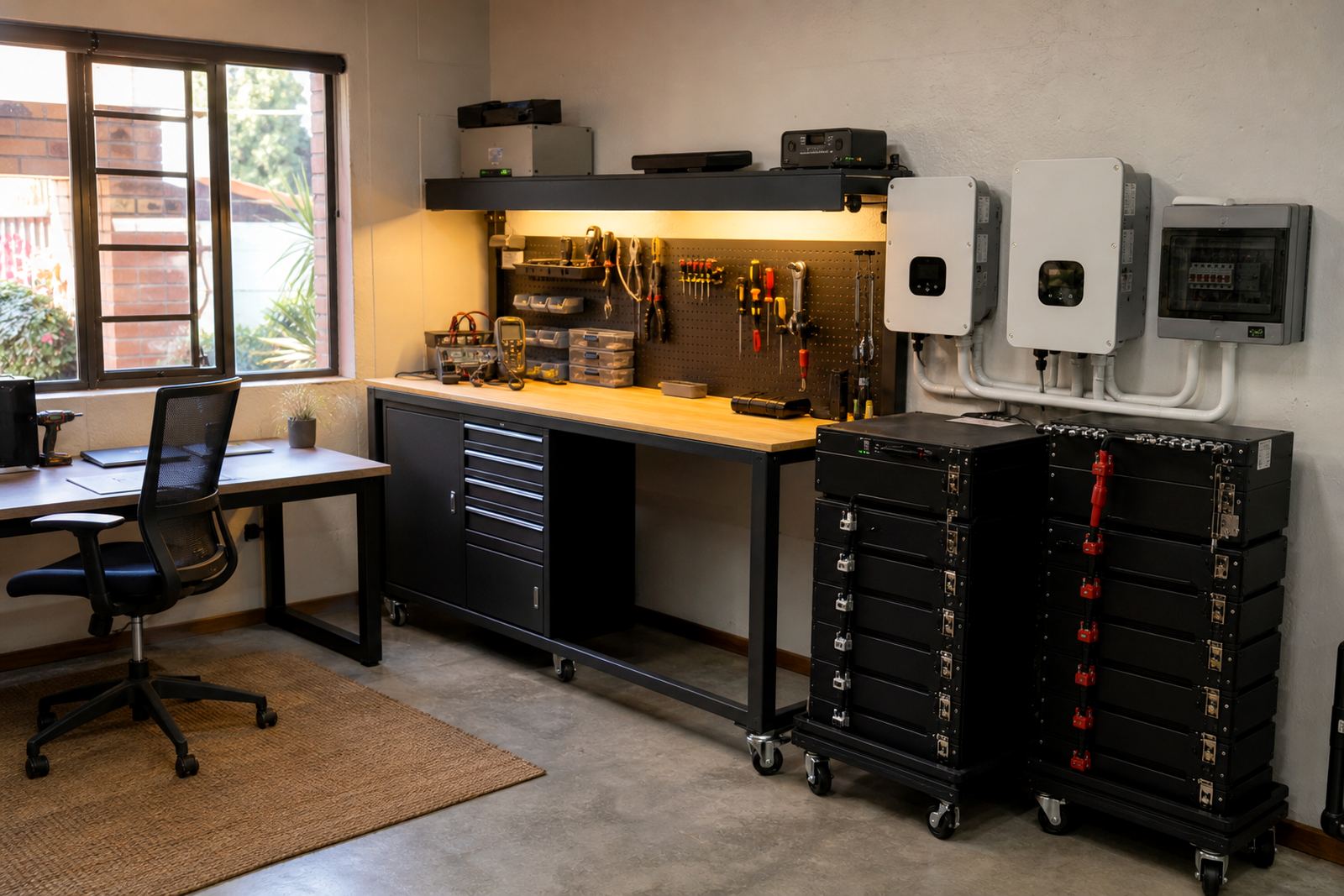
The equipment mix in a warehouse is usually straightforward. The challenge is separating the low-draw items from the high-draw items and making sure the wiring follows a sensible order. An inverter and lithium battery bank can support the admin section, the security room and selected operational points, while the main plant stays off during an outage.
- Inverter with enough output for the essential circuit load
- Lithium battery bank sized for the required runtime
- Changeover gear or essential-load sub-board
- Protection devices and correct cable sizing
- Monitoring setup for battery state and load use
- Optional extra battery capacity for longer outages
For many sites, the right answer is a hybrid style setup that charges from the grid and then carries the essentials through load-shedding. In larger warehouses, the equipment may need to be split across more than one area, for example admin offices on one backup circuit and access control on another. That improves control and makes fault finding easier later on. It also helps when the site has mixed use, like office space on one side and storage or light assembly on the other.
Share what must stay on during an outage and the size of the property, and a backup planner will phone or message you.
Contact formHow to size backup without wasting space or money
Good sizing starts with a real list of loads. We check what each item draws, what starts together, and what can be left off. A router and a few PCs use very little compared with a kettle, aircon unit or motor drive, so the difference between a neat system and a disappointing one often comes down to which circuits are selected. A warehouse backup plan should match the use case, not just the total building size.
As a broad guide, smaller admin-only backup may sit in the lower Rand range, while a system that supports multiple offices, access control and security equipment will move into a mid-range budget. Once essential plant or longer runtime is added, the budget can rise further. We do not give blanket figures because the right setup depends on the number of circuits, battery capacity, cable runs and the quality of the existing distribution board. Still, it is useful to plan in bands rather than guess.
- Small essential office and security backup: often the lower tens of thousands of Rand
- Medium warehouse admin and access control backup: commonly mid tens of thousands of Rand
- Larger multi-area or longer-runtime systems: can move into higher tens of thousands of Rand and beyond
That range is only a planning tool. A clean, well-designed system can cost less than a badly planned one that needs rework after the first outage.
Layout and planning advice for warehouse sites
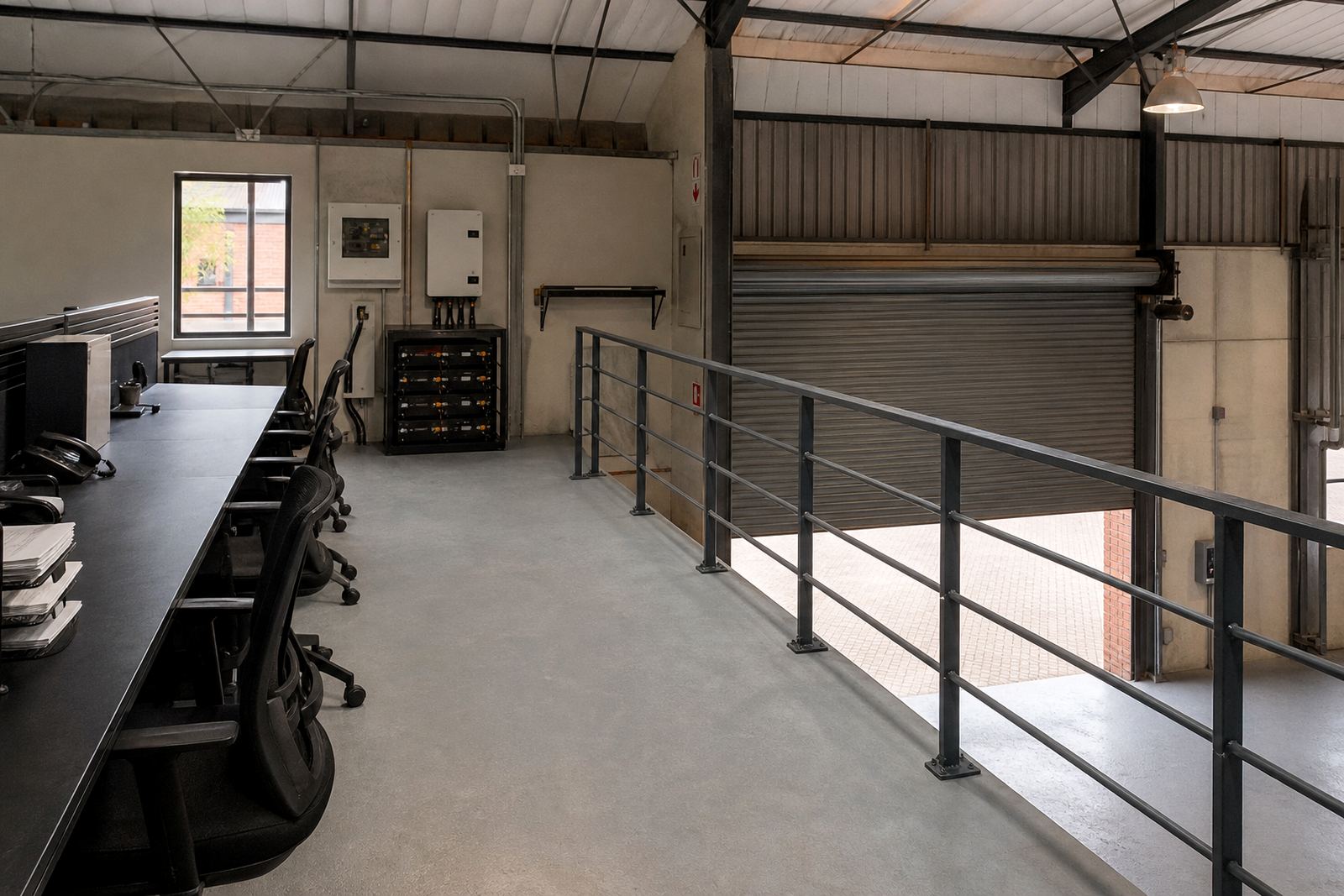
Warehouses work best when the backup system is placed close to the essential load board, with clear cable routing and enough wall space for future battery expansion. If the site has a separate admin block, it may be smarter to back up that section directly rather than trying to run long cable routes across the property. Long runs can add losses, increase installation complexity and make troubleshooting harder.
Another point is ventilation and heat. Inverters and batteries do not like hot, cramped rooms. In Gauteng most sites are inland and dry, but summer heat can still be hard on equipment, and dust is common in storage areas. Coastal humidity is less of a concern here, yet moisture and dust still matter in loading zones and older buildings. The equipment should be mounted in a clean, dry area away from forklift traffic, water lines and places where goods are stacked tightly against the wall. It sounds obvious, but it gets missed more often than it should.
PowerCut plans for practical use, not showroom neatness. If the battery bank is likely to grow later, the initial arrangement should leave physical space and electrical allowance for that expansion. If the site expects future automation or extra cameras, those should be noted from day one.
Common warehouse backup mistakes to avoid
Many warehouse projects go wrong because the backup system is treated like a simple plug-in appliance. It is not. It needs proper load separation, correct protection and enough capacity for the actual site pattern. A few common errors keep appearing across Johannesburg, Pretoria, Centurion, Midrand and Roodepoort.
- Trying to back up the entire warehouse when only a few circuits matter
- Ignoring motor start-up current on gates, pumps or small machinery
- Putting batteries in a hot or dusty room with poor access
- Leaving out future battery expansion when the site is clearly growing
- Not checking whether the existing wiring can handle the new load split
- Forgetting that some equipment should stay off during outages to avoid overload
Another common issue is poor documentation. If the essential circuits are not labelled properly, a future electrician will waste time tracing them. That creates delays during maintenance and can lead to unnecessary downtime. A tidy drawing and correct labels are worth the effort.
Installation, compliance and routine support
All installations must be carried out by a registered electrician, and the work must end with a valid certificate of compliance. If the system is grid-tied, municipal registration is also required. That applies to warehouses just as it does to homes, and it becomes even more important when the site has backup feeding into a distribution board or changeover arrangement. Compliance is not a box-ticking exercise, it is part of making sure the site is safe and legally set up.
PowerCut supports site assessments, backup sizing, inverter installation, battery installation, essential circuit wiring, changeover solutions, system commissioning, compliance support, monitoring setup, battery expansions, fault checks and routine servicing. For warehouse clients, that usually means a practical walk-through first, then a plan based on the essential loads and the expected outage pattern. After that, the focus shifts to reliable operation and easy servicing later on.
For businesses in Randburg and the wider Gauteng area, the best backup system is the one that keeps people working without overcomplicating the site. It should be clear, maintainable and suited to the building, not just the brochure.