What a salon needs during load-shedding
A salon does not need every outlet on backup. In most cases, the priority is lighting, the payment point, Wi-Fi, a sound system and a few low-draw tools that keep the day moving. The aim is to carry on with enough power for service, not to run every dryer and heater at once.
We work with salon owners who need a practical setup for a busy floor in Sandton, a compact room in Roodepoort or a larger site in Centurion. Good planning starts with listing what must stay on, what can wait and what should be switched off during an outage. That keeps the system smaller, cheaper and easier to manage.
- LED lighting on selected circuits
- Card machine and router
- Music system and reception point
- Small clippers, trimmers or charging points
How we size backup for salons
Backup sizing depends on the real load in kilowatts, how long you want to stay open and whether the salon has single or three phase supply. A small treatment room and styling space may only need a modest inverter with one lithium battery, while a larger salon with multiple stations and a wash area may need a bigger battery bank and a neater changeover plan.
We look at peak demand, starting loads and what can be staged. Hair dryers, colour processors and washing equipment can draw a lot, so they are often left off backup unless the system has been designed for it. In humid coastal conditions this matters even more because poor ventilation can shorten equipment life, even in inland branches users still need clean airflow and tidy cable routes.
- Small salon: lights, payment point and music
- Medium salon: above plus selected charging and support circuits
- Larger site: separated backup zones for front of house and treatment rooms
Share what must stay on during an outage and the size of the property, and a backup planner will phone or message you.
Contact formTypical equipment used in a salon backup layout
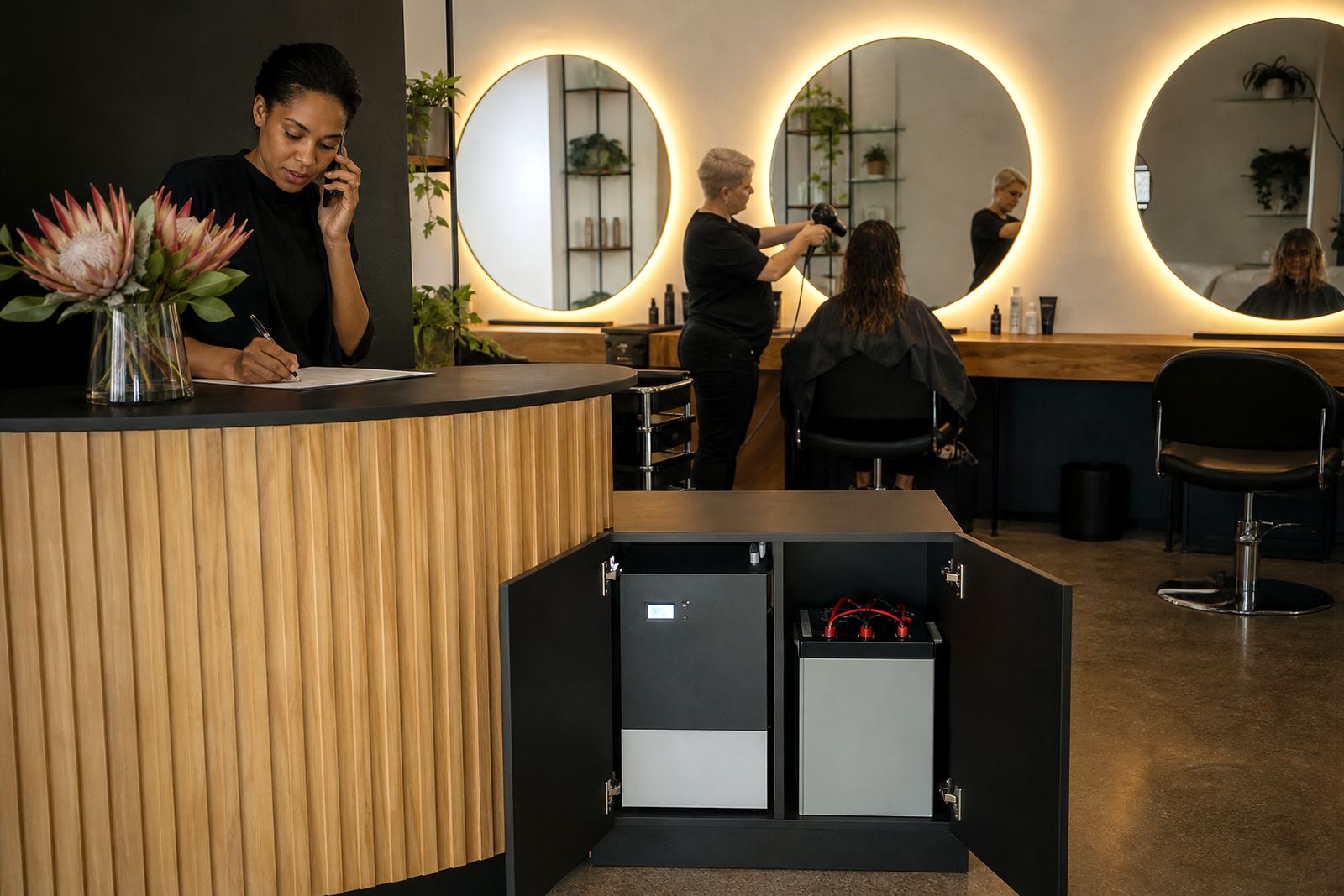
Most salon backup systems use an inverter, lithium battery storage, a changeover arrangement and essential circuit wiring. The inverter converts battery power into usable AC power, while the battery stores energy for the outage period. Lithium batteries are popular because they charge quickly, handle regular cycling well and take up less space than older battery types.
For salons, the layout must be clean and easy to service. Equipment is usually mounted in a secure utility area, storeroom or back office where there is enough ventilation and room for future battery expansion. If the salon uses computers or booking systems, we also plan for safe power to those points so appointments are not lost during a blackout.
Planning advice for busy salons
Good planning avoids surprises. If the salon has multiple rooms, it helps to divide the supply into essential and non-essential circuits. That way the reception, lighting and payment point stay live while energy-hungry appliances remain isolated. We also check the cable runs, the condition of the distribution board and whether the premises need any correction before backup equipment is fitted.
When a salon in Pretoria or Midrand wants to expand later, the system should be planned with that in mind from the start. It is easier to leave space for another battery or a larger inverter than to redo the whole setup later. Battery placement, wall strength and access for maintenance all matter, especially in units where space is tight.
- Keep the card machine, router and reception lighting on one essential circuit
- Leave high-draw devices off backup unless specifically planned for
- Allow space for future battery expansion
- Keep equipment out of direct heat and moisture
Common mistakes salon owners should avoid
The most common mistake is trying to back up every socket. That pushes the system size up and can lead to a setup that still does not last through the outage. Another mistake is forgetting about the start-up surge on certain appliances. A system that looks fine on paper can trip if the load is not assessed properly.
Some owners also skip the compliance side. In South Africa, installations must be done by a registered electrician and the work needs a certificate of compliance. If the system is grid-tied, it also needs municipal registration where required. That applies whether the salon is in Randburg, Fourways or Roodepoort. Getting this right protects the property and keeps the installation above board.
Budget ranges and service support in Gauteng
For salons, backup budgets vary with the size of the space and the number of circuits to be supported. A simple setup for lights, a payment point and music may fall in a lower range, while a larger salon with more stations and reserve capacity will cost more because it needs a bigger inverter, more battery storage and cleaner wiring. As a general guide, salon backup systems can start from around R25 000 and move up to R80 000 or more depending on the load and layout.
PowerCut supports salons across Gauteng from our Randburg base, including Johannesburg, Pretoria, Centurion, Midrand, Roodepoort, Sandton and Fourways. Our services include site assessments, backup sizing, inverter installation, battery installation, essential circuit wiring, changeover solutions, system commissioning, monitoring setup, battery expansions, fault checks and routine servicing. Write to PowerCut through the contact page form and we then work through the load list, the layout and the compliance steps with you.